Most practices track billing the same way they did a decade ago: a monthly report, a denial folder, and a gut feeling about what's going wrong. Medical billing analytics changes that. Instead of reacting to problems after the money is already lost, analytics lets a practice see patterns early enough to actually fix them.
This guide breaks down what medical billing analytics really means, the metrics worth tracking, and how to turn raw claims data into decisions that protect revenue.
What Is Medical Billing Analytics?
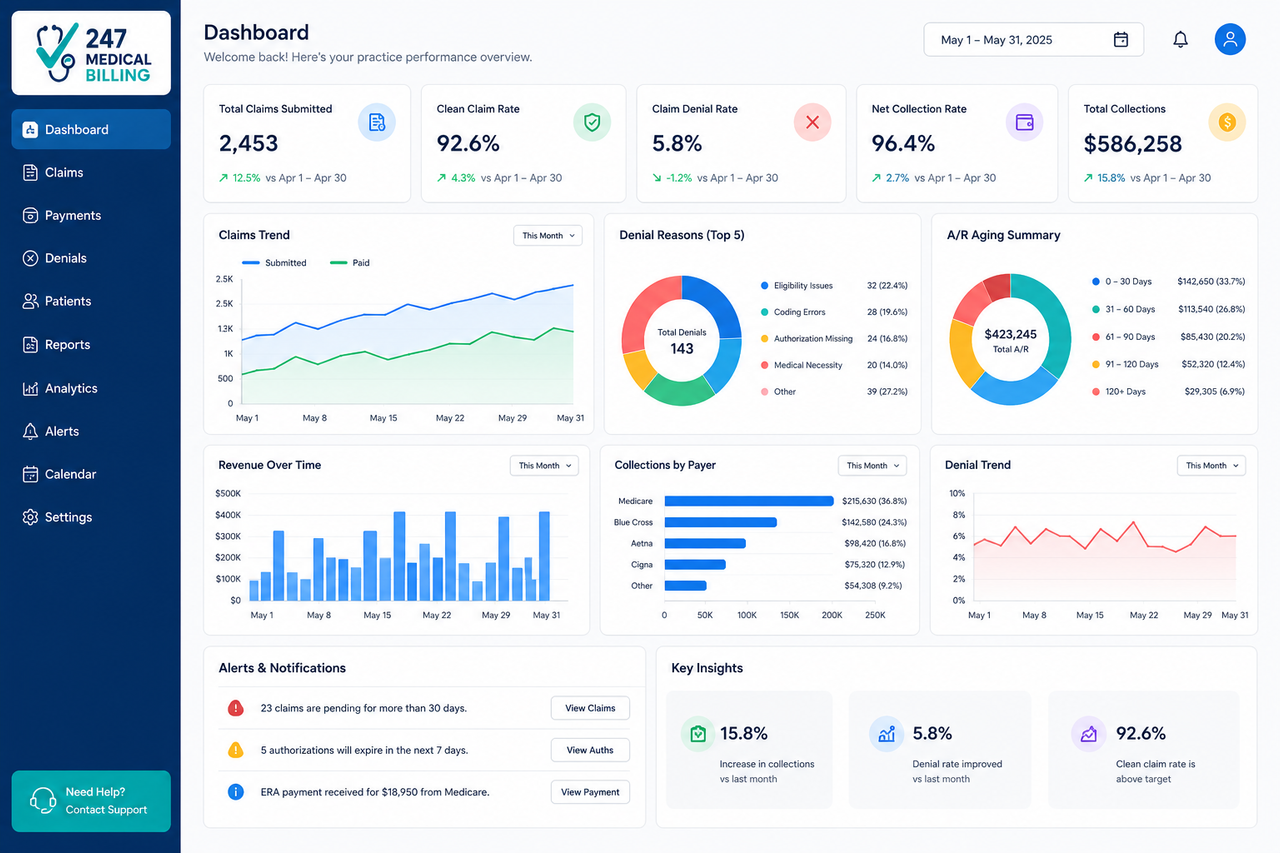
Medical billing analytics is the practice of collecting and analyzing claims, payment, and denial data to understand how a practice's revenue cycle is actually performing, not how it's assumed to be performing. Instead of looking at a single claim in isolation, analytics looks at patterns across hundreds or thousands of claims to answer questions like which payer denies the most, which provider's claims get flagged most often, and which denial reason is quietly costing the most money.
Why Medical Billing Analytics Matters Now
Claim denials remain a stubborn problem across U.S. healthcare. Nearly 20% of claims are denied on average, and as many as 60% of those denials are never even appealed, according to a 2026 McKinsey analysis of the revenue cycle. That's a significant amount of earned revenue simply left on the table, and the problem tends to get bigger in dense, high-volume markets. A practice in a city like New York, for example, often deals with a wider mix of payers and higher claim volume than a small-town practice, which means small, repeatable errors have more room to hide unless someone is actively tracking them.
At the same time, technology adoption is accelerating fast. Roughly 63% of healthcare organizations have already integrated AI-powered automation into their revenue cycle workflows, according to recent HFMA and Experian Health survey data. Practices that aren't using data to guide billing decisions are increasingly competing against ones that are, and the gap tends to show up directly in cash flow.
The Three Types of Medical Billing Analytics
Analytics generally falls into three categories, and a mature billing operation uses all three together.
Descriptive analytics looks backward, showing what already happened, such as last month's denial rate by payer.
Predictive analytics looks forward, flagging which claims are likely to be denied before they're even submitted, based on historical patterns.
Prescriptive analytics goes a step further and recommends or automates the next action, such as routing a high-risk claim for extra review before it ever reaches the payer.
Core Metrics Every Billing Analytics System Should Track
- Denial rate, broken down by payer, provider, and denial reason, not just tracked as one overall number.
- Days in A/R, or how long it takes on average to collect on a claim after submission.
- Clean claim rate, the percentage of claims paid on the first submission.
- Net collection rate, showing how much of what's actually owed gets collected after contractual adjustments.
- Cost to collect, or what it costs in staff time and resources to get a single claim paid.
- Dollar impact by denial reason, ranking denial categories by revenue lost, not just how often they occur.
Tracking these numbers monthly is useful. Tracking them by payer, provider, and denial reason, and watching the trend over time, is what actually turns data into a usable analytics system.
Building a Denial Analytics Dashboard
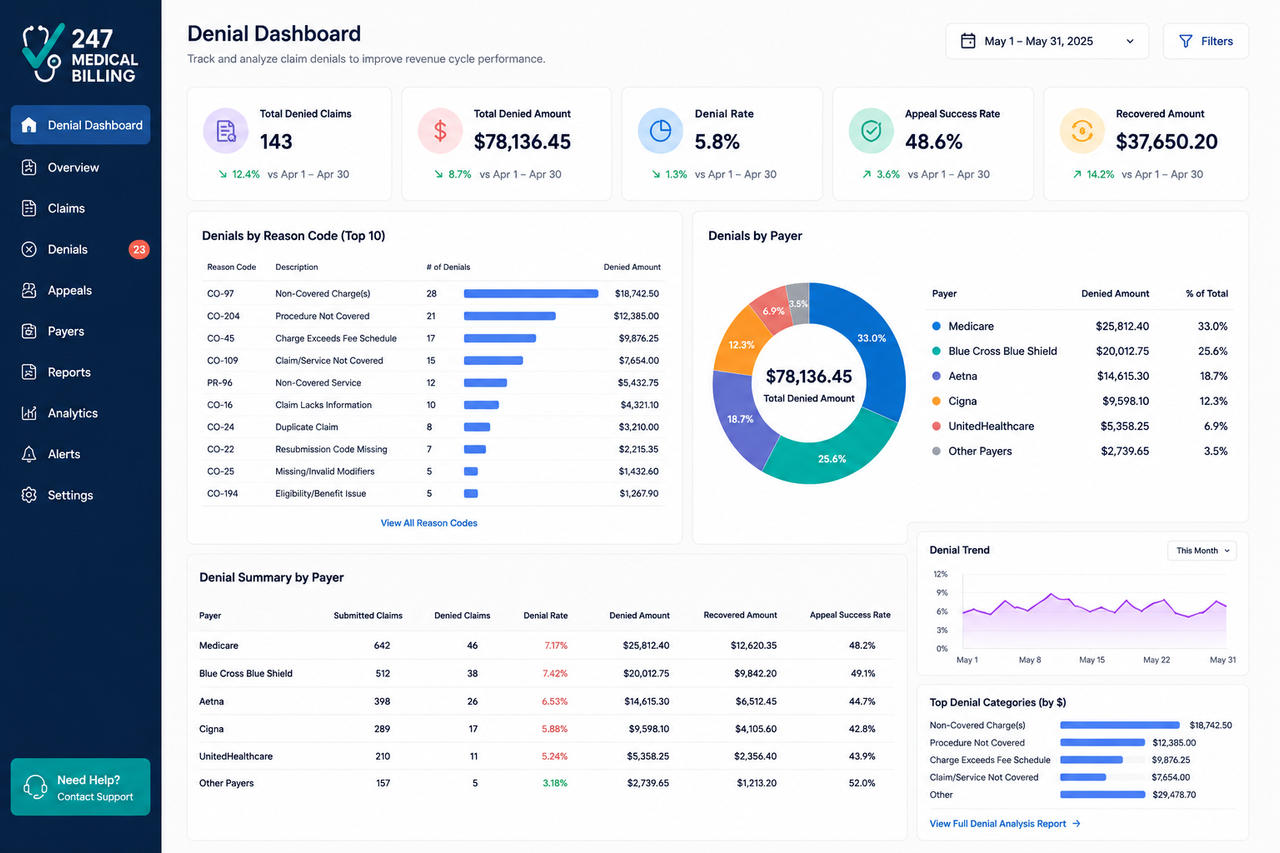
A denial dashboard is usually the single highest-value piece of a medical billing analytics setup, because denials are where revenue leaks fastest. A useful dashboard groups denials by reason code and payer, ranks them by dollar impact, and flags which categories are trending up or down month over month. Practices working with a partner that offers denial management services should expect this kind of structured tracking as standard, not an occasional report.
How Predictive Analytics Helps Prevent Denials Before They Happen
Predictive tools use historical claims data to flag which submissions are most likely to be denied, often before a human even reviews them. Common signals include missing prior authorization, eligibility mismatches, and coding patterns that have historically triggered denials with a specific payer. This isn't only a coding or billing issue either. Enrollment gaps traced back to medical credentialing are a common, preventable driver of denials.
As with most AI-assisted tools in billing, predictive analytics speeds up the first pass, but a trained biller still needs to review flagged claims and confirm the fix before resubmission.
Turning Analytics Into Action: A Simple Framework
- Pull claims data from the last 90 days and group it by payer, provider, and denial reason.
- Rank each group by total dollars affected, not just claim count.
- Pick the top three or four categories and investigate the actual root cause behind each one.
- Fix the process behind the pattern, not just the individual claims sitting in the queue.
- Re-measure in 90 days to confirm the fix actually moved the numbers.
This loop, repeated consistently, is what separates a practice that reacts to denials from one that prevents them.
Common Mistakes Practices Make With Billing Analytics
- Tracking totals instead of trends. A denial rate without a month-over-month trend line tells you where you are, not whether you're improving.
- Looking at claim count instead of dollar impact. A denial type that happens rarely on high-dollar claims can cost more than one that happens often on small ones.
- Treating analytics as a reporting task instead of an action loop. A dashboard nobody acts on is just a nicer-looking spreadsheet.
- Ignoring specialty-specific patterns. Denial trends often look different across specialties, and a one-size-fits-all view can hide what's actually going wrong.
How Medical Billing Analytics Connects to Your Revenue Cycle
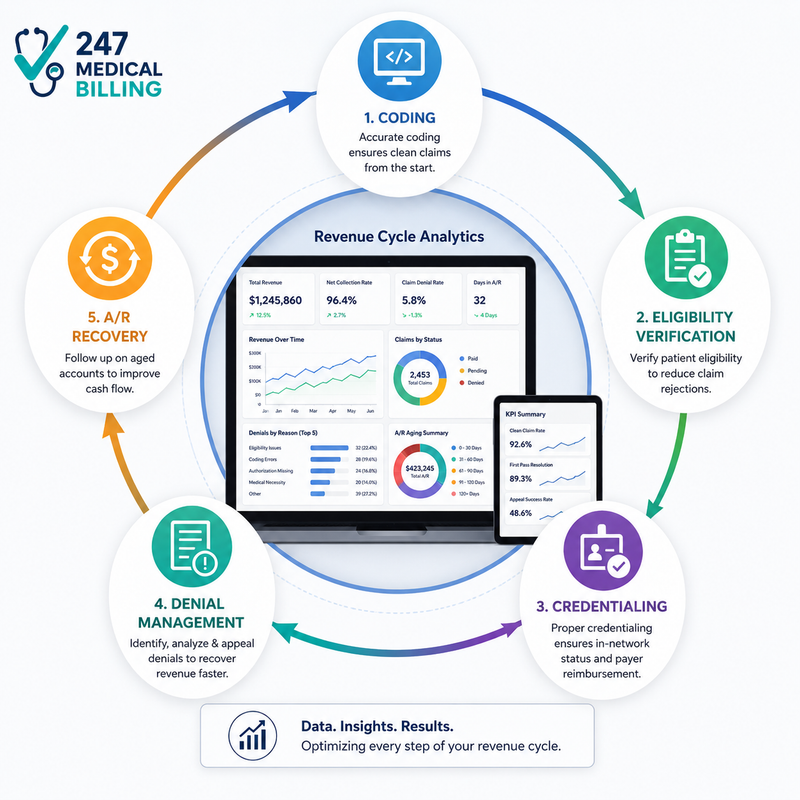
Analytics is only useful if it's connected to the processes it's measuring. Clean medical coding is usually the first thing a denial dashboard points back to when error rates spike. Accurate eligibility verification prevents a large share of the denials that analytics would otherwise be catching after the fact. Claims that stay unpaid too long become a job for accounts receivable recovery, and a periodic medical billing audit helps confirm that what the data shows lines up with what's actually happening on the ground.
All of this should feed into a broader revenue cycle management strategy, rather than treating coding, billing, and denials as separate, disconnected tasks.
Choosing the Right Analytics and Billing Partner
Look for a partner who can show you real dashboards, not just a monthly PDF summary. Ask how they group and rank denials, whether their reporting breaks down by payer and provider, and how quickly they act on what the data shows. Many practices, including several in high-volume markets like New York, choose a partner like 247 Medical Billing, which applies analytics across multiple specialties, because specialty-specific denial patterns are often invisible in a generic, one-size-fits-all report.
FAQs
What is medical billing analytics? It's the use of claims, payment, and denial data to understand and improve how a practice's revenue cycle is performing, rather than reacting to problems one claim at a time.
What's the difference between descriptive and predictive analytics in billing? Descriptive analytics explains what already happened, like last month's denial rate. Predictive analytics forecasts what's likely to happen next, such as which claims are at risk of denial before they're submitted.
What metrics should a small practice track first? Denial rate, days in A/R, and clean claim rate are the highest-value starting metrics, since they capture both speed and accuracy in one view.
Can AI fully automate billing analytics? No. AI can flag patterns and predict risk faster than manual review, but interpreting the results and deciding what to fix still requires human judgment.
How often should billing analytics be reviewed? Monthly at minimum, though denial trends and high-risk claim flags are most useful when reviewed continuously rather than only once a month.
Final Thought
Medical billing analytics isn't about generating more reports. It's about catching the patterns that cost real money before they repeat for another month. Practices that track the right metrics, rank problems by dollar impact, and actually act on what the data shows tend to see fewer denials and faster, more predictable cash flow.
If you want your billing data working for you instead of just sitting in a monthly report, 247 Medical Billing can help. Reach out at contact@247medicalbilling.com or call (888) 603-5358.